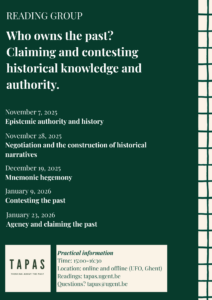
 Reading group: Who owns the Past? Claiming and contesting historical knowledge and authority.
What is ‘history’? Who has the right to narrate the past? This reading group critically explores the concepts of historical authority and historiography. We examine how authority in historical knowledge is attributed — both to individuals and to institutions and practices. At the same time, we interrogate the authority of the notion of ‘history’ itself: what renders historical knowledge legitimate, and who decides that? Drawing on philosophical, historiographical, and memory studies, we analyze how power and epistemic virtues shape historical narratives. How is collective memory subject to hegemonic structures? What is the role of agency in historical representation? This reading group invites an interdisciplinary conversation about the conditions under which history, as a knowledge practice, claims authority — and how that authority can be questioned, shared, or contested.
PRACTICAL INFO
TAPAS reading groups are informal and we welcome all interested colleagues and students to join the discussion. You are welcome to participate in any session that interests you, without any obligation. We will share all literature in advance and organize the sessions both virtually as in person.
- Join us online via Teams or in person at either room 130.002 or Malpertuis at the UFO, third floor (see below).
- We start at 15:00 (CET) and finish around 16:30.
If you have any questions, please do not hesitate to contact us at tapas@ugent.be.
PROGRAM
November 7, 2025 (Room 130.002, UFO)
Epistemic authority and history
- Munslow, A. (1997). Authority and reality in the representation of the Past. Rethinking History, 1(1), 75–87.
- Herman, Paul (2011). “Performing history: how historical scholarship is shaped by epistemic virtues” in History and Theory 50, 1-19.
November 28, 2025 (Room Malpertuis, UFO)
Negotiation and the construction of historical narratives
- Jon A Levisohn, Negotiating Historical Narratives: An Epistemology of History for History Education, Journal of Philosophy of Education, Volume 44, Issue 1, February 2010, Pages 1–21.
- Cobb, S. (2013). Narrative “Braiding” and the Role of Public Officials in Transforming the Public’s Conflicts. Conflict and Narrative: Explorations in Theory and Practice, 1(1), Article 1.
December 19, 2025 (Room 130.002, UFO)
Mnemonic hegemony
- Molden, B. (2016). Resistant pasts versus mnemonic hegemony: On the power relations of collective memory. Memory Studies, 9(2), 125-142.
- Fiedler, A. (2021). Defying Memory? Tracing the Power of Hegemonic Memory in Everyday Discourse Using the Example of National Socialism in Germany. International Journal of Communication, 15(0), Article 0.
January 9, 2026 (Room Malpertuis, UFO)
Contesting the past
- Blouin, F. X., & Rosenberg, W. G. (2011). Processing the Past: Contesting Authority in History and the Archives. Oxford University Press (introduction).
- Poole, R. (2008). Memory, history and the claims of the past. Memory studies, 1(2), 149-166.
January 23, 2026 – POSTPONED TO 13/02 (!) (Room 130.002, UFO or join us via this Teams-link)
Agency and claiming the past
- MATTHES EH. Who Owns Up to the Past? Heritage and Historical Injustice. Journal of the American Philosophical Association. 2018;4(1):87-104. doi:10.1017/apa.2018.13
- Stueber, Karsten R. “Agency and the objectivity of historical narratives.” The Philosophy of History: A Re-examination. Routledge, 2019. 197-222.
- Extra: Ahlskog J. Testimony and Historical Knowledge: Authority, Evidence and Ethics in Historiography. Cambridge University Press; 2025.